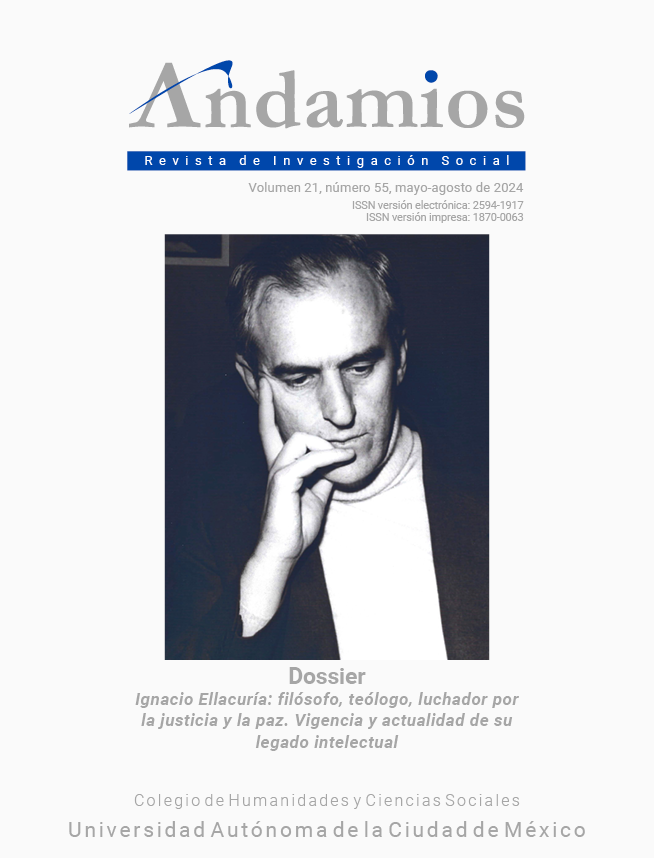
Ignacio Ellacuría’s Theology of Liberation Under Debate with Joseph Ratzinger and Michael Novak
DOI:
https://doi.org/10.29092/uacm.v21i55.1094Keywords:
Liberation theology, historical logos, theology of creativity, Ignacio Ellacuría, Michael NovakAbstract
This article carries out the analysis and understanding of Ignacio Ellacuría’s liberation theology starting from two moments: his response to Joseph Ratzinger’s Instruction on some aspects of “liberation theology”, as well as the critique and reading of the same by the theologian of capitalism Michael Novak –an influential figure in the libertarian liberals such as Javier Milei– and the reading of the historical Jesus as of liberation in the Old Testament. This with the aim of highlighting the praxis of Christianity in the author, as well as its relevance for our present time.
Downloads
References
Downloads
Published
Issue
Section
License
This Journal is licensed under Creative Commons Mexico 2.5. It is allowed to reproduce and disseminate the contents of the Journal for educational or research purposes, not for profit, as long as they are not mutilated and cite the source (Andamios, Revista de Investigación Social) and the author.
The copyright of the articles published in Andamios, Revista de Investigación Social are transferred by the author(s) to Universidad Autónoma de la Ciudad de México when the originals have been accepted, so that they are published and distributed both in the printed and electronic versions of the Journal. However, as established by law, the author(s) retains their moral rights. The author(s) will receive a form of assignment of copyright that they must to sign when their original has been accepted. In the case of collective articles, the signature of one of the authors will suffice, provided that the latter has obtained the consent of the others.
Authors may use the material of their article in other works or books published by themselves, with the condition of quoting Andamios as the original source of the texts.
The articles contained in this publication are the responsibility of their authors and do not compromise the official position of Andamios, Revista de Investigación Social of the Universidad Autónoma de la Ciudad de México.