The affective turn: an embodied view of the migrant experience
DOI:
https://doi.org/10.29092/uacm.v23i60.1249Keywords:
Affective turn, corporality, migration, emotions, collaborative ethnographyAbstract
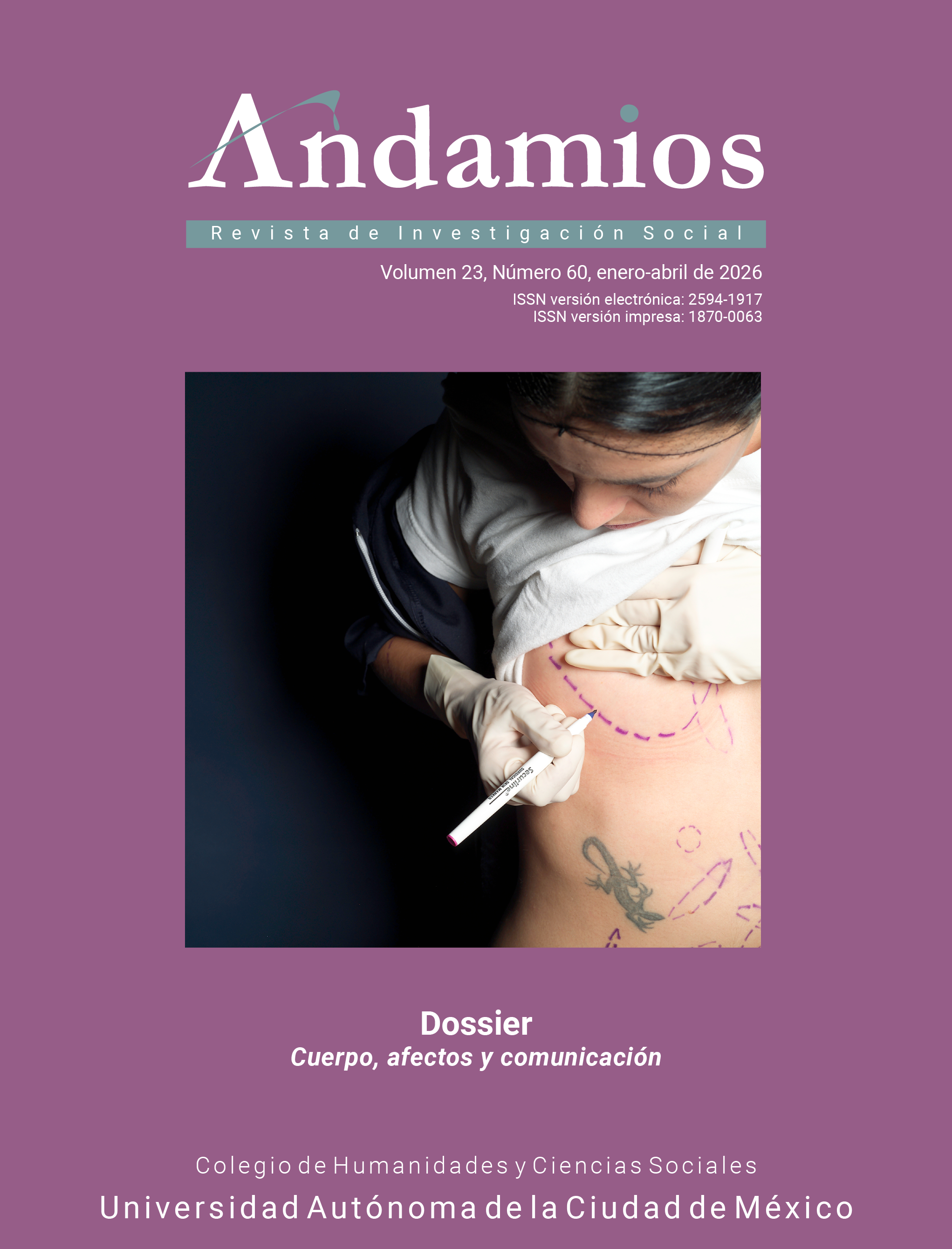
This article aims to discuss how the affective turn allows us to reconfigure our understanding of the migratory phenomenon. Based on the systematization of two research experiences conducted with migrants during their passage through Chiapas, it is argued that emotionality, pain, corporeality, and affect are essential dimensions for understanding human mobility. Using ethnographic and collaborative methodologies, and from a horizontal accompaniment approach, oral and graphic testimonies are made visible as forms of enunciation that denounce structural violence and open possibilities for symbolic and emotional agency. The conclusion is that emotions and bodies, far from being residual or anecdotal, emerge as spaces for knowledge production in contexts of international migration.
Downloads
References
Downloads
Published
Issue
Section
License
This Journal is licensed under Creative Commons Mexico 2.5. It is allowed to reproduce and disseminate the contents of the Journal for educational or research purposes, not for profit, as long as they are not mutilated and cite the source (Andamios, Revista de Investigación Social) and the author.
The copyright of the articles published in Andamios, Revista de Investigación Social are transferred by the author(s) to Universidad Autónoma de la Ciudad de México when the originals have been accepted, so that they are published and distributed both in the printed and electronic versions of the Journal. However, as established by law, the author(s) retains their moral rights. The author(s) will receive a form of assignment of copyright that they must to sign when their original has been accepted. In the case of collective articles, the signature of one of the authors will suffice, provided that the latter has obtained the consent of the others.
Authors may use the material of their article in other works or books published by themselves, with the condition of quoting Andamios as the original source of the texts.
The articles contained in this publication are the responsibility of their authors and do not compromise the official position of Andamios, Revista de Investigación Social of the Universidad Autónoma de la Ciudad de México.