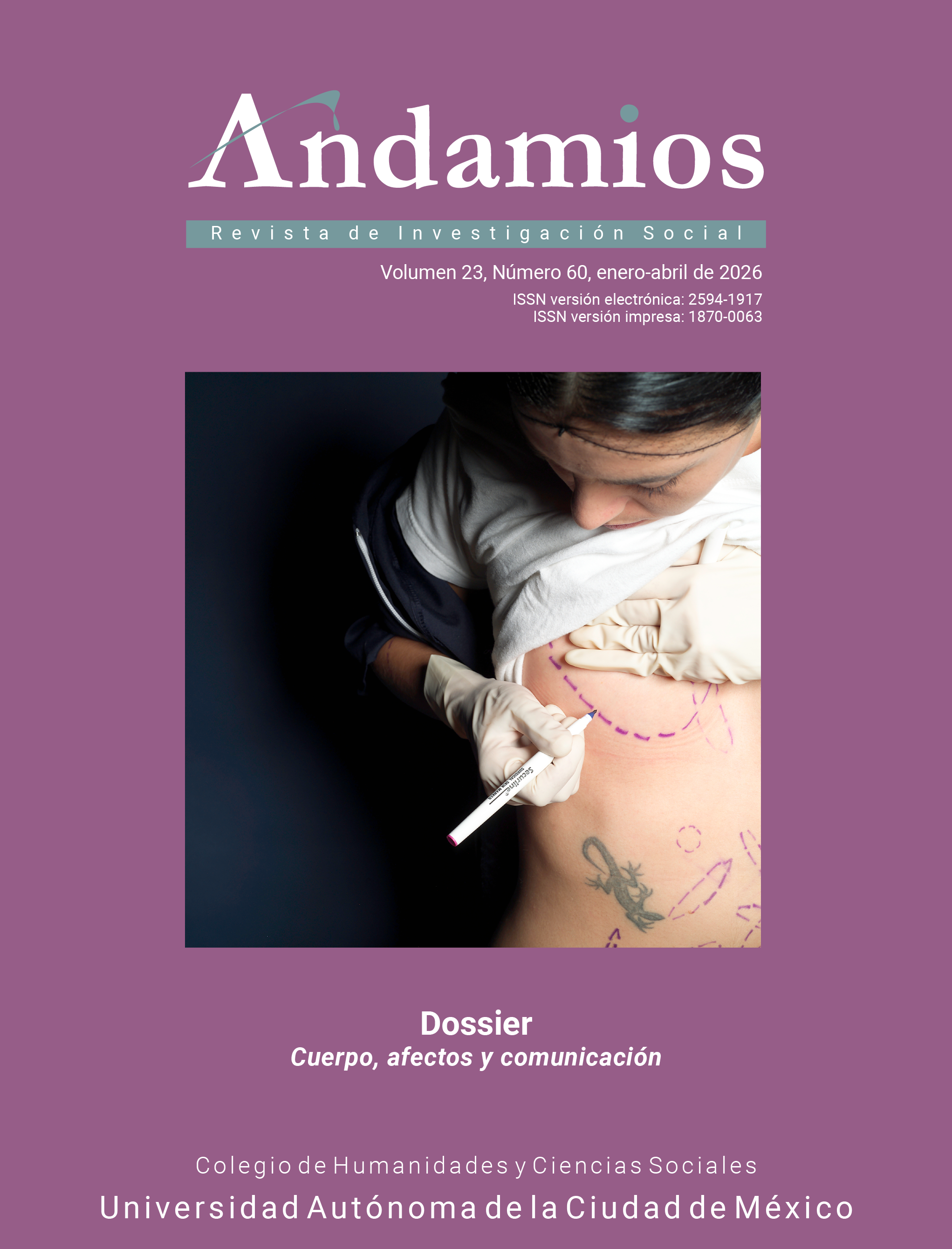
Sensory Ethnography, Body, and Photo-elicitation: Communicating Pain Visually Photographic. Intervention of the family album
DOI:
https://doi.org/10.29092/uacm.v23i60.1251Keywords:
Sensory ethnography, body, visual communication of pain, photo-elicitation, family albumAbstract
This article, the result of research with young women in three regions of Mexico –northwest, west, and central–, shows how the emotional experience of pain linked to events of violence can be approached through sensory ethnography. It develops a proposal for photo-elicitation, a photographic intervention of family albums, taking into account that the body is the vehicle through which we experience and interpret life. The interpretive phenomenological analysis is carried out in three sections: epiphany, contingency, and emotional emergence. Some similarities in the themes presented are both interesting and troubling. This allows us to observe that the intervened and analyzed photographic images become a reflection not only on the people who create them but also on the society that produces them.
Downloads
References
Downloads
Published
Issue
Section
License
This Journal is licensed under Creative Commons Mexico 2.5. It is allowed to reproduce and disseminate the contents of the Journal for educational or research purposes, not for profit, as long as they are not mutilated and cite the source (Andamios, Revista de Investigación Social) and the author.
The copyright of the articles published in Andamios, Revista de Investigación Social are transferred by the author(s) to Universidad Autónoma de la Ciudad de México when the originals have been accepted, so that they are published and distributed both in the printed and electronic versions of the Journal. However, as established by law, the author(s) retains their moral rights. The author(s) will receive a form of assignment of copyright that they must to sign when their original has been accepted. In the case of collective articles, the signature of one of the authors will suffice, provided that the latter has obtained the consent of the others.
Authors may use the material of their article in other works or books published by themselves, with the condition of quoting Andamios as the original source of the texts.
The articles contained in this publication are the responsibility of their authors and do not compromise the official position of Andamios, Revista de Investigación Social of the Universidad Autónoma de la Ciudad de México.