Corporality, gender, and intercultural communication: situated experiences at Universidad Intercultural de Chiapas
DOI:
https://doi.org/10.29092/uacm.v23i60.1253Keywords:
Affect, intercultural communication, corporality, feminisms, territoryAbstract
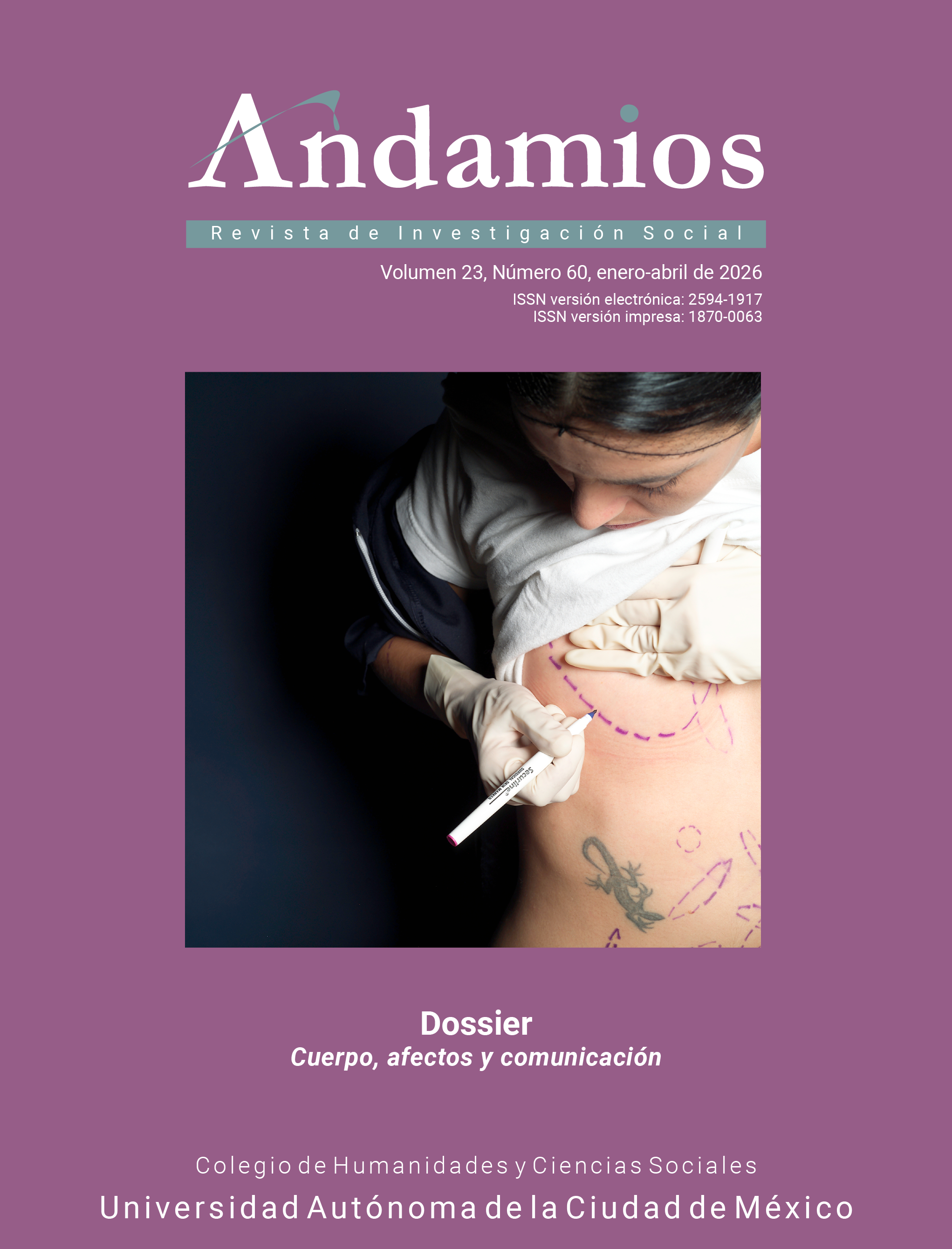
This article, written from a convergence of perspectives, aims to reflect on the perspectives of gender, care, body, and affect as cross-cutting themes in higher education, particularly within the Intercultural Communication program at the Intercultural University of Chiapas (UNICH), from a feminist, socio-spatial, and critical intercultural perspective. For this purpose, two intervention experiences developed with students of the Intercultural Communication program are used as key references: the first during the August-December 2024 semester, and the second in the January-June 2025 semester, with first- and fourth-semester groups, respectively. The methodology implemented is based on social cartography and incorporates autoethnographic observation from ethnography, with exercises in mapping territories and bodies as spaces and mediations in communication.
Downloads
References
Downloads
Published
Issue
Section
License
This Journal is licensed under Creative Commons Mexico 2.5. It is allowed to reproduce and disseminate the contents of the Journal for educational or research purposes, not for profit, as long as they are not mutilated and cite the source (Andamios, Revista de Investigación Social) and the author.
The copyright of the articles published in Andamios, Revista de Investigación Social are transferred by the author(s) to Universidad Autónoma de la Ciudad de México when the originals have been accepted, so that they are published and distributed both in the printed and electronic versions of the Journal. However, as established by law, the author(s) retains their moral rights. The author(s) will receive a form of assignment of copyright that they must to sign when their original has been accepted. In the case of collective articles, the signature of one of the authors will suffice, provided that the latter has obtained the consent of the others.
Authors may use the material of their article in other works or books published by themselves, with the condition of quoting Andamios as the original source of the texts.
The articles contained in this publication are the responsibility of their authors and do not compromise the official position of Andamios, Revista de Investigación Social of the Universidad Autónoma de la Ciudad de México.